
Exness Leverage: Limits, Rules and Risk Management
Access up to 1:2000 leverage with Exness in Tanzania. Trade forex and CFDs with flexible leverage options, instant execution, and secure funding.
 Understand leverage and use it safely in trading:
- Open an Exness trading account
- Exness account types and leverage limits
- Risk management when using leverage
- Forex trading strategies explained
- Forex trading basics for beginners
Leverage Settings on Exness: How It Works in Tanzania
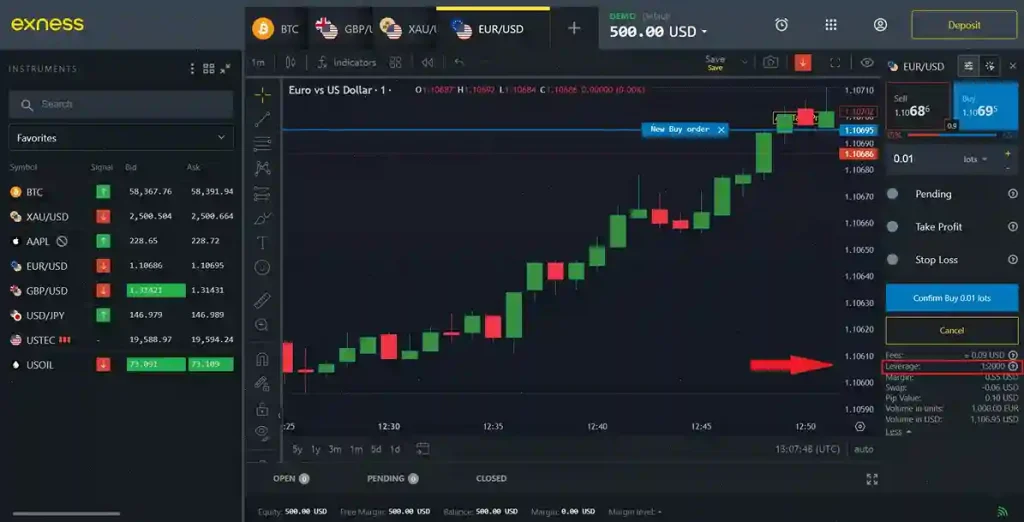
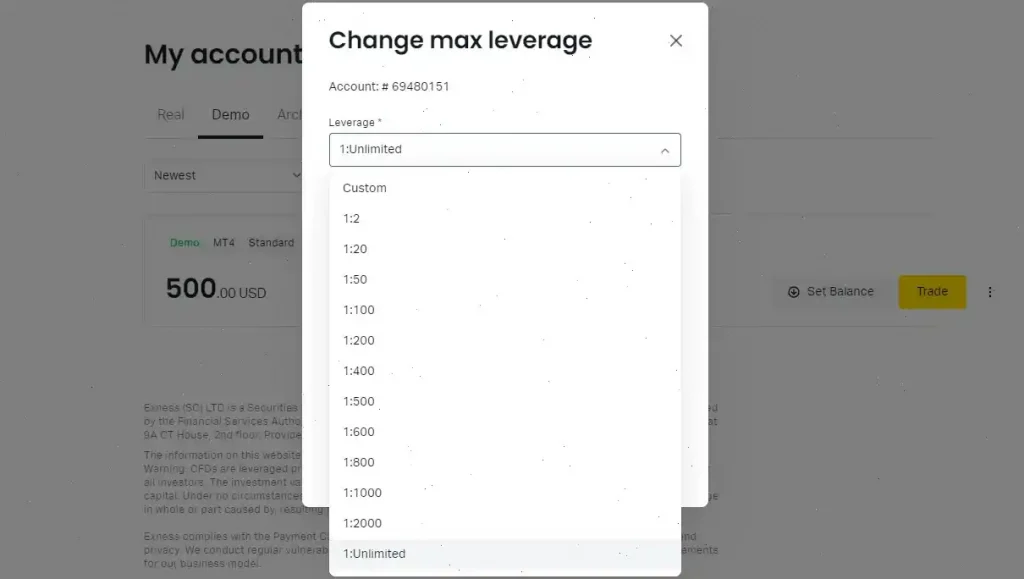
Leverage on the Exness platform is flexible and can range from 1:2 up to 1:2000, depending on the account type and the instrument you trade. In practice, this means a trader with $100 can control positions up to $200,000 at maximum leverage — though most experienced users don’t actually use the full limit due to risk.
For traders in Tanzania, the system adjusts leverage automatically based on account conditions. This is often called dynamic leverage. As your balance or exposure changes, the available leverage may increase or decrease without manual action. It’s noticeable especially when holding larger positions — margin requirements rise quickly.
| Account Type | Max Leverage (Forex) | Max Leverage (CFDs) | Minimum Deposit |
|---|---|---|---|
| Standard | Up to 1:2000 | Up to 1:200 | $10 |
| Pro | Up to 1:2000 | Up to 1:200 | $200 |
| Raw Spread | Up to 1:2000 | Up to 1:200 | $200 |
How Dynamic Leverage Behaves
Instead of staying fixed, leverage changes depending on equity and open trades. For example, traders often notice that after opening several positions, available leverage drops — this is the system limiting exposure. It’s not an error, but a built-in risk control.
This approach can feel restrictive at first, but it prevents situations where a small market move wipes out the account. Especially during volatile sessions (like major news releases), leverage may tighten automatically.
Differences Across Accounts
Although Standard, Pro, and Raw Spread accounts show similar maximum leverage, their trading conditions differ. Raw Spread accounts, for example, typically offer tighter spreads but include a commission per trade. This matters more in short-term strategies where cost per trade adds up.
Leverage limits are also lower for volatile assets like cryptocurrencies. This reflects the higher price swings — even 1:10 leverage on crypto can lead to rapid gains or losses.
Changing Leverage in Your Account
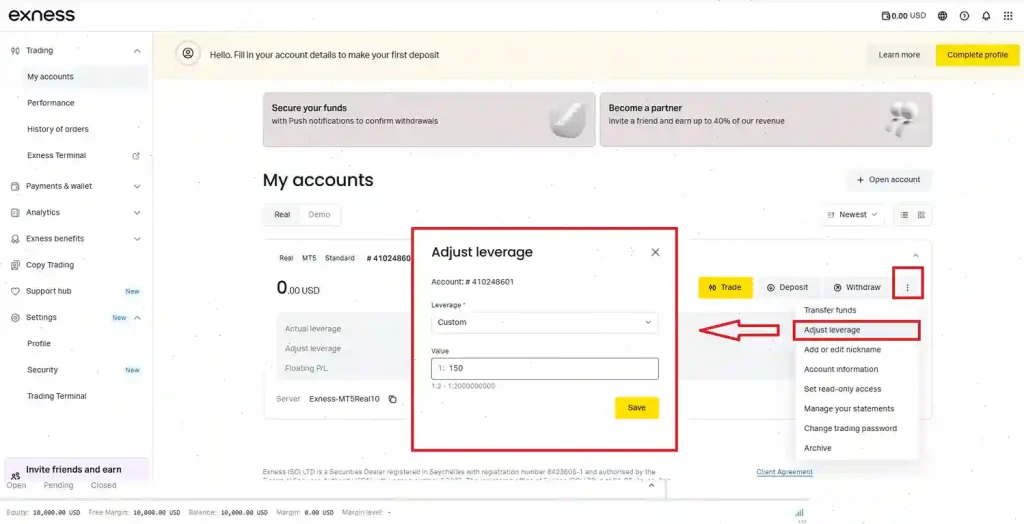
Leverage can be adjusted directly from the Exness Personal Area. Most traders in Tanzania use either the mobile app or browser login, depending on their device. The process itself takes less than a minute.
- Open your Personal Area via the website or app
- Select the trading account you want to edit
- Find the leverage settings option
- Choose a new ratio from the list
- Save changes
The update applies only to new positions. Existing trades keep their original leverage, which avoids unexpected changes in margin during active trades.
Margin and What It Means in Practice
Margin is the amount required to open a trade. It’s calculated simply: position size divided by leverage. For example, opening a $10,000 position at 1:100 leverage requires $100 margin.
The platform shows this value before confirming any trade. If funds are not sufficient, the order won’t be executed — something beginners often encounter when trying to open multiple positions at once.
Margin Call and Stop Out
When account equity drops and margin level reaches around 60%, a margin call warning appears. At this stage, positions are still open, but the situation requires attention.
If the level falls further to about 20%, stop out activates. Positions begin closing automatically, starting with the largest losses. This mechanism limits further losses, but it also means trades are closed without manual control.
Free Margin Explained
Free margin is what remains after accounting for used margin. It fluctuates constantly with price movement. If it reaches zero, opening new trades becomes impossible.
In practice, many traders monitor free margin more closely than balance, since it reflects real trading capacity.
Leverage Across Different Markets
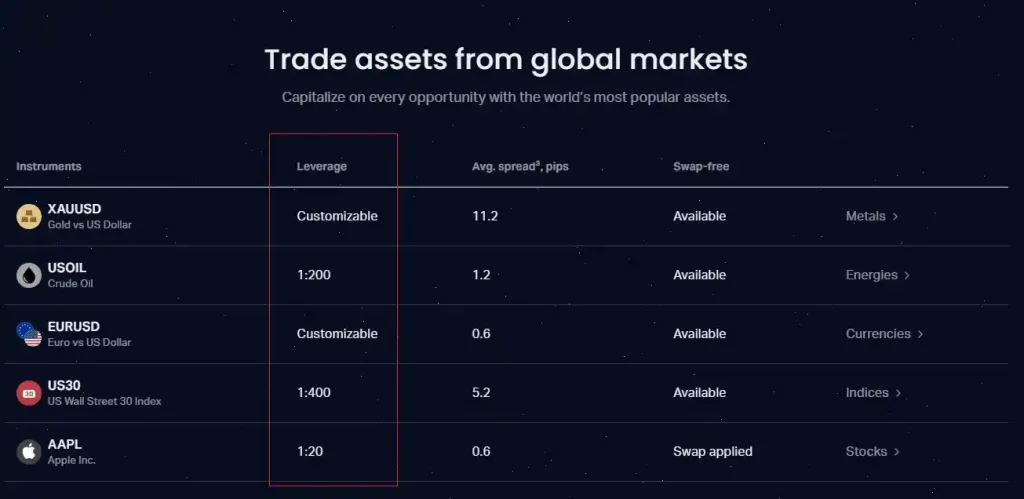
Leverage isn’t одинаков for all instruments. It depends on volatility and liquidity. Forex pairs generally allow higher ratios, while assets like crypto or indices come with tighter limits.
| Instrument | Max Leverage | Approx. Margin | Trading Hours |
|---|---|---|---|
| Major Forex | Up to 1:2000 | ~0.05% | 24/5 |
| Minor Forex | Up to 1:1000 | ~0.1% | 24/5 |
| Gold & Silver | Up to 1:500 | ~0.2% | 24/5 |
| Indices | Up to 1:200 | ~0.5% | Session-based |
| Crypto | Up to 1:10 | ~10% | 24/7 |
Forex Trading Conditions
Pairs like EUR/USD or GBP/USD usually have the highest leverage limits. This is partly because of their liquidity — spreads are often lower, and execution tends to be faster (sometimes under a few milliseconds).
CFDs and Commodities
Gold and oil are traded with moderate leverage, often up to 1:500. Overnight fees (swap) apply if positions stay open, and these costs vary depending on interest rates and market conditions.
Risk Considerations When Using Leverage
High leverage can amplify both profits and losses. A small price movement — even less than 1% — can significantly affect account equity when leverage is high.
- Negative balance protection prevents losing more than your deposit
- Stop loss helps define acceptable loss per trade
- Take profit locks gains automatically
- Trailing stop adjusts dynamically with price
Many traders in Tanzania prefer using lower leverage (like 1:100–1:500) for more stable risk control, especially when trading longer timeframes.
Deposits and Funding Options in Tanzania
Funding methods available locally make a difference in how quickly traders can react to market conditions. Mobile money is widely used in Tanzania due to speed and accessibility.
| Method | Processing Time | Min Deposit | Max Deposit |
|---|---|---|---|
| M-Pesa | Instant | $10 | $2000 |
| Bank Transfer | 1–3 days | $50 | $50,000 |
| Card | Instant | $10 | $5000 |
| Crypto | 30–60 min | $10 | $10,000 |

Mobile payments like M-Pesa or Airtel Money are often preferred because funds appear almost immediately. This matters when margin levels are low and quick action is required.
Platforms and Leverage Control Tools
Exness supports MetaTrader 4 and MetaTrader 5, both commonly used in Tanzania. These platforms display margin, leverage, and equity in real time.
Using MetaTrader
When placing trades, margin requirements update instantly based on volume. Traders using automated strategies (Expert Advisors) often include leverage limits directly in their settings.
Mobile Trading
The Exness mobile app allows quick adjustments without logging into a desktop. Notifications about margin calls are pushed instantly, which is useful when trading on the go.
How Traders Approach Leverage in Practice
Different trading styles use leverage differently. Scalpers tend to use higher ratios due to small price targets, while swing traders usually prefer lower leverage to withstand market swings.
| Style | Typical Leverage | Execution | Notes |
|---|---|---|---|
| Scalping | Up to 1:2000 | Fast execution | Relies on tight spreads |
| Swing Trading | 1:100 – 1:500 | Standard | Holds trades for days |
| Hedging | Flexible | Depends | Used for risk balancing |
There’s no single “correct” leverage setting. Many traders adjust it depending on market conditions rather than sticking to one fixed value.
 FAQ
FAQ
What is the maximum leverage available on Exness in Tanzania?
For major forex pairs, leverage can go up to 1:2000 depending on account conditions and equity.
Can leverage be changed after opening trades?
No, changes apply only to new positions. Existing trades keep their original settings.
Which deposit method is commonly used in Tanzania?
Mobile money services like M-Pesa are widely used because of instant processing and ease of access.